From wuji to taiji
The ancient Chinese sages called the empty, boundless space before the creation of the visible world "wuji" - the limitless, the nothing. It has no form and yet is formed; it has an appearance and no appearance. This "phenomenon of emptiness" is the source of movement and stillness. Laozi called it the "Tao", and the teaching of the Tao and how it shows itself in a person is the foundation of the internal martial art of Fei Jing.
Taiji is born from wuji, and its name means "great limit". It is the source of dynamic and static states, and the mother of the two primal forces - Yin and Yang.
The idea describes not only the creation of the universe, but all relationships - between people, between objects, between people and objects. An empty room is in a state of wuji; when people enter it, they bring movement and the taiji stage begins. The "emptiness" is Yin, and what comes out of it is Yang.
Yin and Yang
Yin and Yang are complementary opposites that unite into one whole. Where there is day, there must be night: day is Yang, night is Yin. Heaven is Yang, earth is Yin. Yang is the active, the hot, the positive; Yin is the passive, the cold, the negative. All the techniques, footwork, strikes and blocks in Fei Jing are built on this concept.
Why red and black
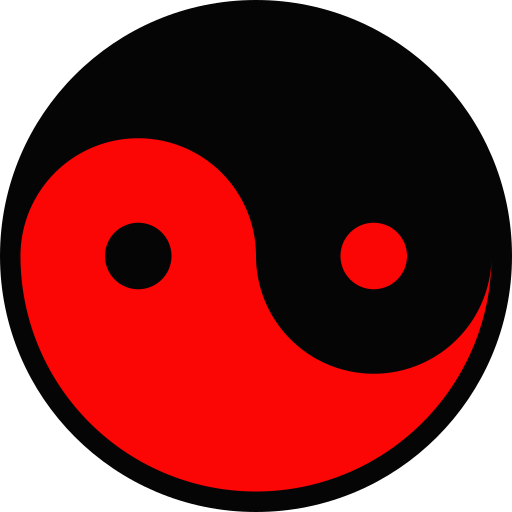
The Fei Jing symbol, the "taiji diagram" (known in the West as the monad), is red and black. It is usually drawn in black and white, but the original colour of Yang is red - the embodiment of the element of fire. Black is the element of water.
- The curved line. The line dividing Yin and Yang is curved, not straight. A straight line would mean stillness; the curve shows dynamic, circular movement, and the changes in its curvature show different speeds.
- The direction. Clockwise movement is considered positive, and anticlockwise negative. In Fei Jing it is in the positive direction, which defines the passive character of the style: every technique begins by blocking the attack and developing a counter-attack.
- Fire beneath water. Yang is below and Yin is above. In this way the fire constantly regulates the amount of water, and the two forces are in permanent harmony. This is called the "complete model".